We Robot will come to Berlin: April 23rd – 25th 2026

We Robot is an interdisciplinary, peer-reviewed conference that brings together leading scholars and practitioners to discuss legal, ethical and policy implications of robots and other emergent digital technologies. Since its inception in 2012, the conference has fostered dynamic conversations regarding robot theory, design, ethics and development. We Robot has been hosted in Yale, Stanford, Ottawa, Seattle, Miami, Boston and Windsor (CA) in the past.

Recognized as one of North America’s most exciting interdisciplinary conferences on the societal implications of robotics, We Robot is now expanding to Europe, marking a significant step toward international collaboration and practical solidarity in the academic world. We Robot 2026 in Berlin wants to encourage the exchange of diverse perspectives and academic insights from all around the world. It wants to discuss pathways towards a responsible, accessible and trustworthy use of technology for the common good.

We Robot 2026 will create an international platform to discuss current and future AI and robotics policy, especially at a time when legal frameworks are evolving in different directions around the world. A major focus of the 2026 edition will be a comparative analysis of different approaches to regulation, with the goal of fostering mutual learning and dialogue.

The conference seeks to bring together scientists, policymakers, business leaders, and the broader expert community to discuss shared strategies for managing the rapid advancements in robotics and AI.


CONFERENCE PROGRAMME – WE ROBOT 2026 – BERLIN

We are excited to announce the preliminary programme for the 14th annual We Robot Conference to be held on April 24 and 25, 2026, with a pre-conference workshop on April 23, 2026. The final conference programme will be available on March 19, 2026, following the final paper submission deadline. 

Pre-Conference Workshop – 23rd April 2026 (Thursday)

Morning session: Diving into the future at the House of Robotics, where cutting-edge research is rewriting what machines can do.
Location: House of Robotics 

Afternoon session: Get ready to roll up your sleeves! Workshop activities will dive deep into the conference’s themes (agentic AI, robot ethics, and beyond) before crowning the ultimate robot knowledge champion in a fierce Robot Trivia face-off.
Location (Afternoon session): Wikimedia Deutschland 

Main Conference – 24th and 25th April 2026 (Friday & Saturday)

Location: buM – Place for Solidarity

Across two enriching days, the conference programme is structured around individual paper presentations and panel discussions, designed to facilitate meaningful dialogue and foster engagement across disciplinary boundaries. And because the best conversations don’t always happen in the conference room, join us for the conference dinner on the 24th where the energy, ideas, and good company keep flowing long into the evening. 

Paper Sessions: 

  • From Limited Risk to Prohibited Use: Mapping the EU AI Act’s Risk Framework onto Robotic Public Safety Systems.
    Author: Irmak Erdogan (KU Leuven Centre for IT & IP Law))
  • Rethinking Robot Ownership: Comparing Public, Corporate, and Private Ownership Models.
    Authors: Isaac Sheidlower, Tomo Lazovich, Harini Suresh, and Serena Booth (Brown University)
  • Reimagining the Three Laws of Robots: Ethical Principles from Field Deployment for Adaptive Governance
    Authors: Tomomi Ota (Shiga University) and Rikiya Yamamoto (Robot Friendly Project)
  • From Rejection to Regulation: Mapping the Landscape of AI Resistance
    Authors: Ayse Gizem Yasar (École normale supérieure Paris) and Can Simsek (Alexander von Humboldt Institute for Internet and Society)

Panel: AI Safety and assurance: Technological foundations, standards and audits 

  • Protocols as Custom: A Case for Negligence in Agentic Artificial Intelligence
    Authors: Veronica Paternolli (University of Verona) and Ryan Calo (University of Washington)
  • Revealing AI’s Latent Rulebook
    Authors: David Atkinson (Georgetown) and Paul Ohm (Georgetown Law)
  • A Scoping Review of System Integration Audits: Towards a New Class of Artificial Intelligence Evaluation
    Authors: Leah Davis (McGill University), Ajung Moon (McGill University) and Dominic Martin (Université du Québec à Montréal (UQAM))

Panel: Reimagining Accountability: Who Answers When Systems Fail? 

  • Intention, But Hybrid: A New Test for Posthuman Agents
    Author: Janko Munjić (Appellate Court in Kragujevac; Faculty of Law, University of Kragujevac
  • AI Risk Bonds: A Market-Based Mechanism for Governing Liability
    Authors: Gleb Papyshev (Lingnan University), Sara Migliorini (University of Macau) and Keith Jin Deng Chan (The Hong Kong University of Science and Technology)
  • Curated Information Frameworks: Contextual Transparency and Governance for Dynamic AI
    Author: Emily LaRosa (Michigan State University)

Panel: Building Systems That Last: Law, Technology, and Long-Term Thinking 

  • The Charge of Green Robots: From Environmental Robot Ethics to an Environmental Rule of Law for Robotics
    Authors: Jacopo Ciani, Ugo Pagallo, Massimo Durante and Ludovica Paseri (Department of Law, University of Turin)
  • When Right to Repair Meets AI: Reinterpreting the Right to Repair through Individuation
    Author: Ryota Akasaka (The University of Osaka) 
  • Robotic Imposters with Human Helpers: An anthropologically informed study of sociotechnical imaginaries around social robots in staged and unstaged settings in Japan
    Authors: Elsa Concas (Stockholm University), Laetitia Tanqueray (Department of Technology and Society, Lund University) and Stefan Larsson (Department of Technology and Society, Lund University) 

Panel: Deep Fakes and Deeper Problems: AI’s Problem with Nuances 

  • Ambiguity Collapse & LLMs
    Author: Shira Gur-Arieh (Harvard Law School)
  • How Much Is My Voice Worth to an Algorithm? Synthetic Voices, Embodied Agents, and the Right to Freedom from Vocal Identity Confusion
    Author: Maddalena Castellani (Attorney-at-law and Independent Researcher)

Registration for the conference is open now!

We are delighted to announce that registration for We Robot 2026 in Berlin is open now.

Register here on PreTix!


We will foresee opportunities for interested students or professionals who cannot afford the participation fee – such as volunteering options or waivers. Contact us!


What WeRobot 2026 offers.

At WeRobot, technology is not only discussed in abstract terms. Through demos and side events (such as visits to research institutions) participants can experience robots and ai applications up close. They are introduced to the state of the art in technology and research, enabled to experiment with robots, and invited to engage in direct dialogue with their developers.

Promote Science

Experience interdisciplinary exchange at the highest level. Our conference provides a platform for presenting and discussing the latest findings. Your participation promotes your research and science as a whole.

Experience Technology

Immerse yourself in the world of the latest technologies! Look forward to exciting tech demos and side events where you can experience innovative developments first hand. Be inspired by technical solutions.

Networking

Take the opportunity to make valuable connections! Our conference is the ideal place to network with scientists, experts and industry leaders. Expand your professional network for future collaborations.

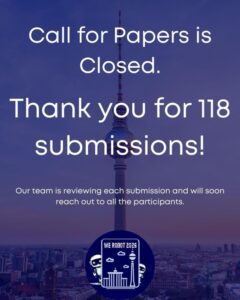
Call for Papers

Our interdisciplinary and international Programme Committee has started their reviews.

Feedback to authors can be excepted by mid-January 2026!

Register for the conference here!

Location

Get in touch!

Hosting organisations

Donors, Sponsors and Academic Partners

Interested in supporting WeRobot 2026 as a sponsor and partner?
Contact us: orga@werobot2026.eu

Organizing Committee

Programme Committee

Benjamin Brake (former Head of Unit, Federal Ministry of Digital Affairs)

Lee Andrew Bygrave (University of Oslo)

Ryan Calo (University of Washington)

Jennifer Cobbe (University of Cambridge)

Mila Dalla Preda (University of Verona)

Kate Darling (RAI Institute)

Jan de Bruyne (KU Leuven)

Suzie Dunn (Dalhousie’s Schulich School of Law)

Martin Ebers (RAILS)

Eduard Fosch-Villaronga (Leiden University)

Michael Froomkin (University of Miami)

Sabine Gless (University Basel)

Sue Glueck (Independent Scholar)

Nikolas Guggenberger (University of Houston)

Woodrow Hartzog (University of Boston)

Maximilian Kiener (Institute for Ethics in Technology Hamburg)

Natalie Leesakul (University of Nottingham)

Jason Millar (University of Ottawa)

Laurel Riek (University of California San Diego)

Hannah Ruschemeier (University of Osnabrück)

Giovanni Sartor (University of Bologna)

Burkhard Schafer (University of Edinburgh)

Bill Smart (Oregon State University)

Katie Szilagyi (University of Manitoba)

Helena Webb (University of Nottingham)

Stanislaw Tosza (University of Luxembourg)

Hosted by Robotics and AI Law Society (RAILS)

Media partners

Conference logo by Windsor Law/Dalia Defilippi & Kristen Thomasen/Berlin adaption by Tobias B. Bacherle